Humanity occupies a strange place between galaxies and atoms. We are almost nothing when viewed from above, yet almost unimaginably enormous when viewed from below.
Stand somewhere along the coast of Cape Coast after sunset and look towards the Atlantic. Even before you begin thinking about stars, the horizon already makes you feel small. The ocean stretches beyond sight, the sky refuses to reveal its edges, and suddenly the problems that occupied your whole mind during the day seem to lose some of their authority.
Then you remember that the ocean is only a thin puddle on the surface of one planet. Earth is one world orbiting one ordinary star, inside one galaxy among an almost incomprehensible number of galaxies.
The universe has a ruthless way of making the human ego look badly overfunded.
But there is another direction in which we can look. Instead of travelling outward through planets, stars and galaxies, we can travel inward—through organs, tissues, cells, molecules, atoms and the particles inside them.
From that direction, the story changes completely.
We may be too small in the universe to matter in any obvious cosmic sense. But compared with the microscopic worlds beneath our skin, we are also impossibly large. We are not only specks living inside something enormous. Each of us is also an enormous environment made from smaller things.
We are cosmic dust and walking universes at the same time.
The View from Very Far Away
NASA estimates that the observable universe is approximately 92 billion light-years across. That is only the part whose light has had enough time to reach us. Scientists still do not know whether the entire universe is finite, vastly larger than the observable region, or infinite.
A light-year is the distance light travels in one year. Light moves so quickly that it could circle Earth more than seven times in a single second. Yet it still requires about 100,000 years to cross the Milky Way.
Our galaxy, enormous as it is, is only one among hundreds of billions of galaxies. NASA places the age of the universe at approximately 13.8 billion years. Human civilisation occupies only the thinnest scratch at the end of that timeline.
Against such numbers, one human life seems almost offensively brief. Eighty years is not a chapter in cosmic history. It is not even a sentence. It is closer to the tiny movement of a cursor before the document closes.
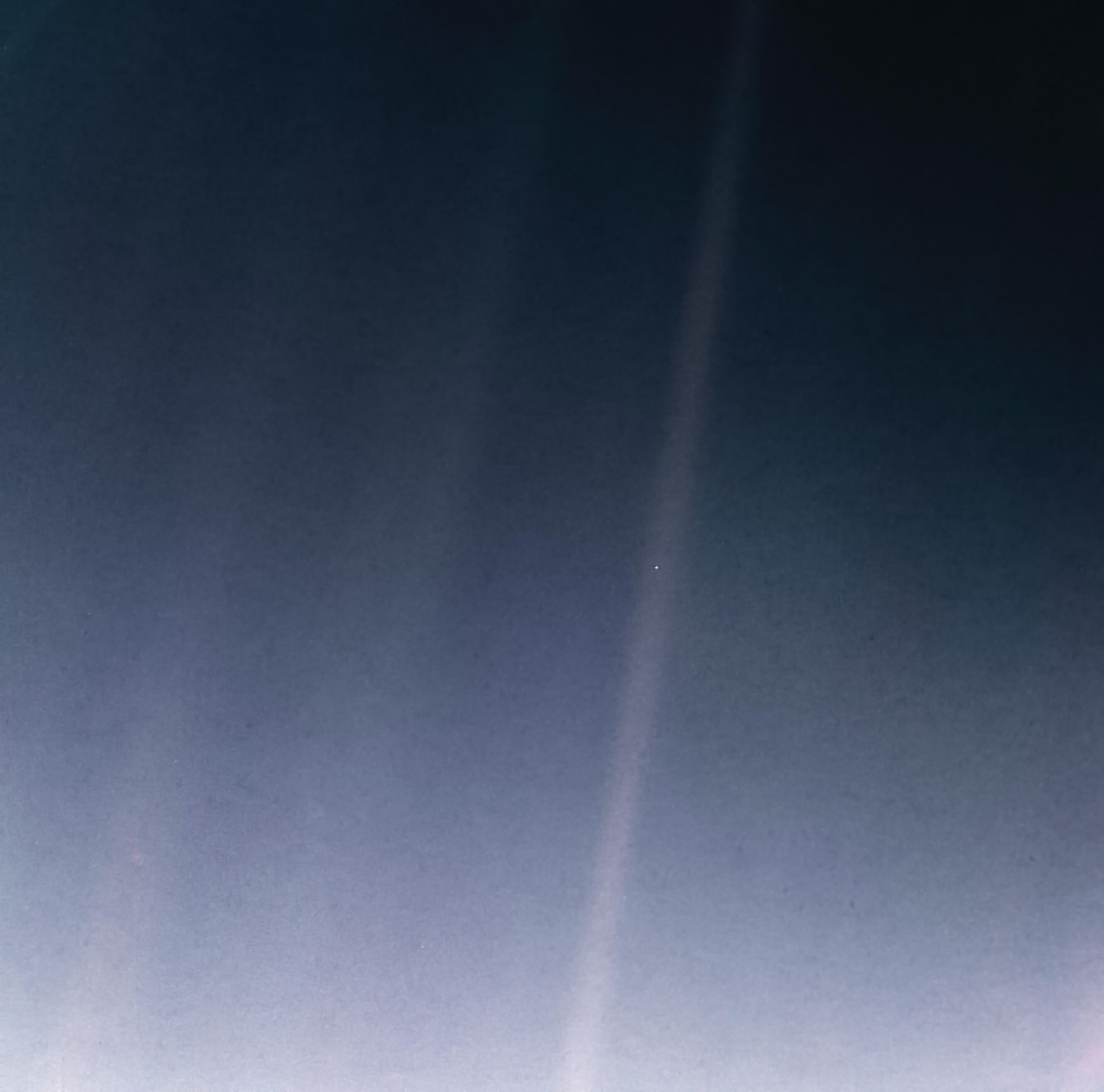
Voyager 1 demonstrated our smallness without needing equations. In 1990, from roughly six billion kilometres away, the spacecraft turned its camera back towards Earth. Our entire planet appeared as a pale point of light, approximately one pixel in the image.
Every empire, border, religion, election, breakup, wedding, examination, war and family argument happened on that dot. Every person who believed they were the centre of the story lived there too.
It is difficult to remain arrogant after seeing our planet reduced to a pixel.
Now Turn the Telescope Around
Cosmic scale makes us look microscopic. Atomic scale makes us look colossal.
An atom is one of the smallest units of ordinary matter that retains the chemical properties of an element. According to the International Atomic Energy Agency, approximately 500,000 carbon atoms could be stacked across the width of a single strand of human hair.
That strand of hair, which looks almost negligible to us, would be an enormous structure at atomic scale.
Atoms themselves contain even smaller structures. At the centre is a nucleus containing protons and neutrons, surrounded by an electron cloud. The nucleus is astonishingly small relative to the atom. The IAEA offers a useful comparison: if an atomic nucleus were enlarged to the size of a marble, the entire atom would be comparable to a sports stadium.
This is where people often say that atoms are “mostly empty space.” That description is useful, but it can also be misleading. The space is not simply a miniature vacuum containing tiny planets orbiting a sun. Electrons behave according to quantum mechanics and are represented by probability clouds, while forces and fields govern how matter interacts.
Your body feels solid because the atoms within it interact through electromagnetic forces. The chair beneath you is not solid in the simple, everyday sense either. Its atoms resist the atoms in your body, producing the dependable experience we call solidity.
At this level, reality becomes much stranger than common sense prepared us for.

You Are Not One Small Thing
We usually experience ourselves as single individuals. I have one name, one body and one continuous sense of being “me.” Biology tells a more complicated story.
A major 2023 analysis estimated that adult human bodies contain tens of trillions of human cells. These cells vary enormously in size and function. Some transport oxygen. Some contract to move muscles. Some transmit electrical signals. Others defend the body, repair damage or produce the substances that keep the whole system alive.
Most of these cells will never understand the complete person they collectively create. They simply respond to local signals and perform specialised work. Yet from those countless interactions emerges a human being capable of remembering childhood, fearing the future, designing machines, falling in love and asking why anything exists.
From the perspective of a skin cell, your body is not a person walking to class. It is the entire surrounding environment. Blood vessels are transport networks. Chemical signals carry instructions. The immune system patrols for threats. Nutrients arrive, waste leaves, structures break and repairs begin.
You are less like a simple object and more like a highly coordinated event that has somehow learned to call itself by a name.
To the universe, we are almost nothing. To the worlds beneath our skin, we are almost everything.
We Are Made from the Thing That Makes Us Feel Small
The separation between humanity and the universe is partly an illusion. We speak about “us” and “the universe” as though we were visitors dropped into it from somewhere else.
But we are not merely inside the universe. We are pieces of it.
The carbon in our cells, the oxygen moving through our blood, the calcium in our bones and the iron involved in carrying oxygen were produced through cosmic processes. Stars fused lighter elements into heavier ones, while stellar deaths and other violent events scattered those materials into space. NASA’s explanation that humans are made from star material is not just poetic language. It is chemistry.
Ancient matter became stars. Stars manufactured elements. Those elements entered clouds of gas and dust, then planets, oceans, living cells and eventually brains capable of studying stars.
The universe did not merely create something that could live inside it. Through us, it produced matter capable of examining matter.
That does not prove that humanity has a divine mission or that the cosmos was designed with us in mind. We should be careful not to turn scientific wonder into convenient certainty. But it does mean that consciousness is one of the most extraordinary transformations of matter we currently know.
The atoms in your brain obey the same physical laws as atoms inside stones. Yet arranged in a particular living system, they produce thoughts, memories, imagination and the unsettling ability to wonder whether thoughts themselves matter.
Size and Importance Are Not the Same Thing
When people say humanity is too small to matter, they quietly assume that physical size determines value. That is a strange rule.
A virus can be microscopic and still transform global history. A damaged cell can threaten an entire body. A small electrical signal in the brain can move a hand, form a sentence or begin a decision that changes millions of lives.
Large things are not automatically important, and small things are not automatically irrelevant.
A distant galaxy may contain billions of stars and still know nothing about your suffering. A friend sitting beside you may occupy almost no space by cosmic standards yet recognise your pain and help you survive it.
Meaning is not measured in kilometres.
Perhaps the universe does not assign importance at all. Perhaps there is no cosmic committee calculating our significance. Meaning may instead emerge wherever conscious beings can experience joy, fear, loss, love and possibility.
If a person suffers, that suffering matters because it is being experienced—not because the universe pauses to acknowledge it. If someone is loved, that love matters within the lives it changes. Local meaning is still real meaning.
We do not need the entire universe to notice us before we are allowed to care about one another.
But We Are Also Too Big to Pretend We Are Powerless
Our smallness can become a convenient excuse.
What difference can one person make? What difference can one country make? Why protect one forest, one language, one animal or one community when everything will eventually disappear?
That sounds philosophical, but it is often just irresponsibility wearing a galaxy-print shirt.
Humans may be insignificant compared with the observable universe, but we are immensely powerful within the part of it we actually occupy. Our species can split atomic nuclei, edit genes, dam rivers, remove forests, move mountains and send machines beyond the solar system.
Our collective activity has become powerful enough to alter Earth’s atmosphere and climate. NASA states that human activity is the principal cause of the current rapid warming of Earth.
That is what it means to be too big.
We are too influential to behave as though our choices disappear after we make them. A decision in a boardroom can reshape an ecosystem. A discovery in a laboratory can improve millions of lives or create a new weapon. A technology built by a small team can alter how entire generations communicate, learn and understand reality.
Cosmically, we are tiny. Planetarily, we are giants.
The Correct Response Is Neither Despair nor Arrogance
Looking at the universe can produce two opposite mistakes.
The first is nihilism: we are small, therefore nothing matters.
The second is human exceptionalism: we are intelligent, therefore everything exists for us.
I find both positions unsatisfying.
Our smallness should destroy the fantasy that the universe revolves around us. Our power should destroy the fantasy that our actions have no consequences.
We need a posture that can hold both truths at once:
- We are small enough to remain humble.
- We are complex enough to remain curious.
- We are vulnerable enough to need one another.
- We are powerful enough to be responsible.
This perspective changes how we approach ordinary life. Many of the differences we use to divide humanity become ridiculous when Earth is seen from space. Borders disappear. Social status disappears. The categories over which people discriminate and kill one another cannot be detected from Voyager’s camera.
Yet individual lives do not disappear simply because the planet looks small. If anything, Earth’s isolation makes each life more precious. As far as we currently know, this tiny world is the only place where humans can breathe, argue, create music, write stories and complain about Monday mornings.
That is not proof that we are the centre of existence. It is a reminder that our home is rare to us and cannot be casually replaced.
We Live Between Two Infinities
Above us are scales so large that language begins to fail. Beneath us are scales so small that ordinary intuition stops working.
Between them stands the human being: a temporary arrangement of ancient atoms, containing trillions of living cells, standing on a small planet and trying to understand a universe whose true size remains unknown.
We are not the largest thing. We are not the smallest thing. We may not be the most important thing. But we are here, and for a brief period, we are capable of noticing.
Perhaps that is enough.
We are too small to justify our arrogance. We are too large to justify our apathy. We are tiny enough to be humbled by the stars and powerful enough to determine what happens to much of the life around us.
The universe may never announce that humanity matters. It may remain silent forever.
But we can matter to one another. We can protect the small world that produced us. We can use our brief consciousness to understand, create, repair and care.
And on a pale dot surrounded by darkness, that is already an enormous responsibility.
Read or leave a comment Loads only when opened
No comments:
Post a Comment